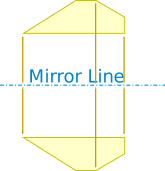
Though a reflection does preserve distance and therefore can be classified as an isometry, a reflection changes the orientation of the shape and is therefore classified as an opposite isometry. You can see the change in orientation by the order of the letters on the image vs the preimage.
In mathematics, a reflection (also spelled reflexion) [1] is a mapping from a Euclidean space to itself that is an isometry with a hyperplane as the set of fixed points; this set is called the axis (in dimension 2) or plane (in dimension 3) of reflection.
Reflection in mathematics is a geometric transformation where a shape or object is flipped across a line, known as the line of reflection. This results in a mirror image that is the same size and shape as the original but appears flipped or mirrored.
To reflect objects over horizontal or vertical lines that are not the x- or y-axes, the following steps can be used: Draw the line of reflection. Consider the line of reflection and object being reflected to be a single object.
In math, "reflection" is a type of transformation that flips a shape or figure across a line, creating a mirror image. The line over which the figure is flipped is called the "line of reflection." Reflection rules help us understand how points or shapes are moved during this process.
A reflection is a type of transformation that flips a figure over a line. Master reflecting figures over different lines in this interactive, free lesson!
While any point in the coordinate plane may be used as a point of reflection, the most commonly used point is the origin. Assume that the origin is the point of reflection unless told otherwise.
A reflection is a type of transformation where a figure is flipped over a line (called the line of reflection), creating a mirror image of the original shape. In a reflection, every point of the shape is mapped to the opposite side of the line at the same distance from that line.