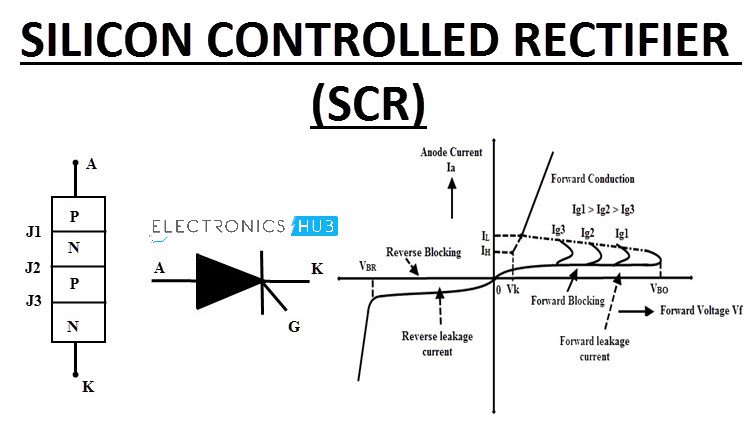
 In this tutorial, we will learn about Silicon Controlled Rectifier (SCR). We will learn its symbol, structure, working, Turn ON and Turn OFF methods and some applications. The Silicon Controlled Rectifier (SCR) is the most important and mostly used member of the thyristor family.
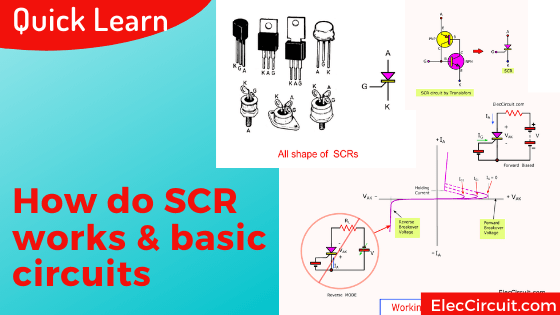 The SCR (Silicon Controlled Rectifier) is a type of electronic switch used in power control. This guide explains how it works and shows simple SCR circuits for beginners.
 In this thyristor tutorial, we will look at the construction and operation of the thyristor, also known as a Silicon Controlled Rectifier, or SCR in more detail, and see that it is basically a four-layer semiconductor device which can be used in various switching applications.
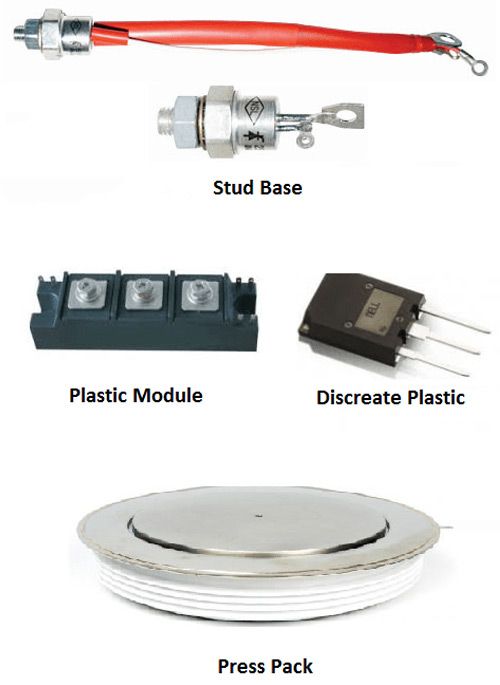 SCR has four layers of extrinsic semiconductor materials. These four layers form three PN junctions named J1, J2, and J3. The layers are either NPNP or PNPN. The anode and cathode terminals are placed at the end layers, and the gate terminal is placed in the third layer.
 A Silicon Controlled Rectifier (SCR) is defined as a unidirectional semiconductor device made of silicon. It functions like a solid-state thyratron, also known as a thyristor.